UI GreenMetric World
University Ranking 2025

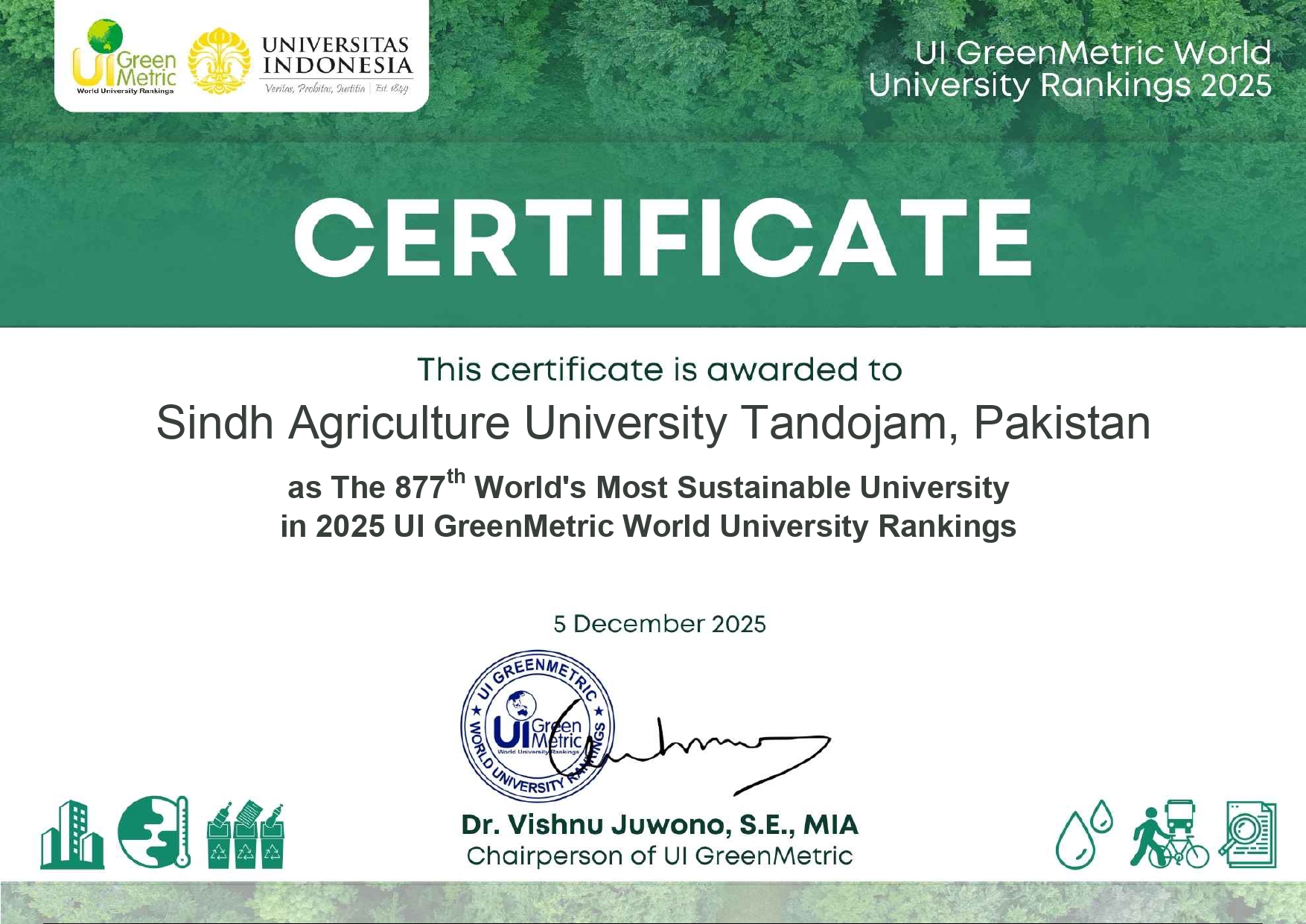
Sindh Agriculture University Tandojam, Pakistan has been proudly recognized as the 877th World's Most Sustainable University in the 2025 UI GreenMetric World University Rankings — a testament to our unwavering commitment to environmental sustainability and green campus initiatives.

Established 1977
Tandojam, Pakistan
1,745 Universities
World Rank 877 out of 1,745
0
World Rank
0
National Rank
5647.5
Total Score
56.48%
Performance


What is UI GreenMetric?

UI GreenMetric World University Rankings is an annual sustainability ranking initiated by Universitas Indonesia, assessing universities worldwide based on their commitment to sustainability and green campus practices since 2010.

Global Recognition

Over 1,745 universities from 105 countries participate, making it the world's largest sustainability-focused university ranking system.

6 Key Indicators

Comprehensive evaluation across Setting & Infrastructure, Energy & Climate Change, Waste, Water, Transportation, and Education & Research.

Sustainable Future

Encourages continuous improvement in sustainable campus practices and positions universities as powerful drivers of environmental change.

Category-wise Scores

Detailed breakdown of SAU Tandojam's sustainability performance across all six evaluation categories

Setting & Infrastructure
800 / 1500
53.33%
Energy & Climate Change
1300 / 2100
61.90%
Waste Management
850 / 1800
47.22%
Water Management
625 / 1000
62.50%
Transportation
1185 / 1800
65.83%
Education & Research
887.5 / 1800
49.31%
Score Distribution
Total Score
5647.5 / 10000

Indicator-wise Scores

Complete breakdown of scores across all 39 indicators in six categories

Setting & Infrastructure (SI)

800 / 1500
SI.1 The ratio of open space area to total area
100 / 200
SI.2 Total area on campus covered in forest vegetation used for research, teaching, and/or community engagement
25 / 100
SI.3 Total area on campus covered in planted vegetation
150 / 200
SI.4 Total area on campus for water absorption besides the forest and planted vegetation
50 / 100
SI.5 The total open space area divided by total campus population
150 / 200
SI.6 Percentage of university budget for sustainability efforts
50 / 200
SI.7 Campus facilities for disabled, special needs and/or maternity care
75 / 100
SI.8 Security and safety facilities
50 / 100
SI.9 Health infrastructure facilities for students, academics and administrative staffs' well-being
50 / 100
SI.10 Conservation: plant (flora), animal (fauna), or wildlife, genetic resources for food and agriculture secured
50 / 100
SI.11 Planning, implementation, monitoring and/or evaluation of all programs related to Setting and Infrastructure through ICT
50 / 100

Energy & Climate Change (EC)

1300 / 2100
EC.1 Energy efficient appliances usage
150 / 200
EC.2 Smart building implementation
150 / 300
EC.3 Number of renewable energy sources on campus
75 / 300
EC.4 Total electricity usage divided by total campus population (kWh per person)
100 / 200
EC.5 The ratio of renewable energy production divided by total energy usage per year
100 / 200
EC.6 Elements of green building implementation as reflected in all buildings
200 / 200
EC.7 Greenhouse gas emission reduction program
150 / 200
EC.8 Total carbon footprint divided by total campus population (metric tons per person)
150 / 200
EC.9 Number of innovative program(s) in energy and climate change
100 / 100
EC.10 Impactful university program(s) on climate change
75 / 100
EC.11 Planning, implementation, monitoring and/or evaluation of all programs related to Energy and Climate Change through ICT
50 / 100

Waste Management (WS)

850 / 1800
WS.1 3R (Reduce, Reuse, Recycle) program for university's waste
150 / 200
WS.2 Program to reduce the use of paper and plastic on campus
225 / 300
WS.3 Organic waste treatment
150 / 300
WS.4 Inorganic waste treatment
75 / 300
WS.5 Toxic waste treatment
75 / 300
WS.6 Sewage disposal
150 / 300
WS.7 Planning, implementation, monitoring and/or evaluation of all programs related to Waste Management through ICT
25 / 100

Water Management (WR)

625 / 1000
WR.1 Water conservation program & implementations
113 / 150
WR.2 Water recycling program implementation
150 / 200
WR.3 Water efficient appliances usage
100 / 200
WR.4 Consumption of treated water
100 / 200
WR.5 Water pollution control in the campus area
150 / 200
WR.6 Planning, implementation, monitoring and/or evaluation of all programs related to Water Management through ICT
13 / 50

Transportation (TR)

1185 / 1800
TR.1 The total number of vehicles (cars and motorcycles) divided by total campus population
200 / 200
TR.2 Shuttle services
188 / 250
TR.3 Zero Emission Vehicles (ZEV) availability on campus
150 / 200
TR.4 The total number of Zero Emission Vehicles (ZEV) divided by total campus population
10 / 200
TR.5 Ratio of the ground parking area to the total campus area
150 / 200
TR.6 Program to limit or decrease the parking area on campus for the last 3 years
100 / 200
TR.7 Number of initiatives to decrease private vehicles on campus
150 / 200
TR.8 The pedestrian path on campus
188 / 250
TR.9 Planning, implementation, monitoring and/or evaluation of all programs related to Transportation through ICT
50 / 100

Education & Research (ED)

887.5 / 1800
ED.1 The ratio of sustainability courses to total courses/subjects
200 / 200
ED.2 The ratio of sustainability research funding to total research funding
100 / 200
ED.3 Ratio of scholarly publications on sustainability to lecturers/researchers on campus in one year period
50 / 200
ED.4 Number of events related to sustainability (environment)
38 / 150
ED.5 Number of activities organized by student organizations related to sustainability per year
38 / 150
ED.6 University-run sustainability website
150 / 200
ED.7 Sustainability report
75 / 100
ED.8 Number of cultural activities on campus (e.g. Cultural Festival)
25 / 100
ED.9 Number of university sustainability program(s) with international collaborations
25 / 100
ED.10 Number of community services related to sustainability organized by university and involving students
25 / 100
ED.11 Number of sustainability-related startups
25 / 100
ED.12 Percentage of number of graduates with green jobs (for the last 3 years)
38 / 50
ED.13 Availability of unit or office that coordinate sustainability on campus
50 / 50
ED.14 Planning, implementation, monitoring and/or evaluation of university governance through ICT
50 / 100

World Rankings History

SAU Tandojam's journey through UI GreenMetric World University Rankings over the years

2019
2020
2021
2022
2023
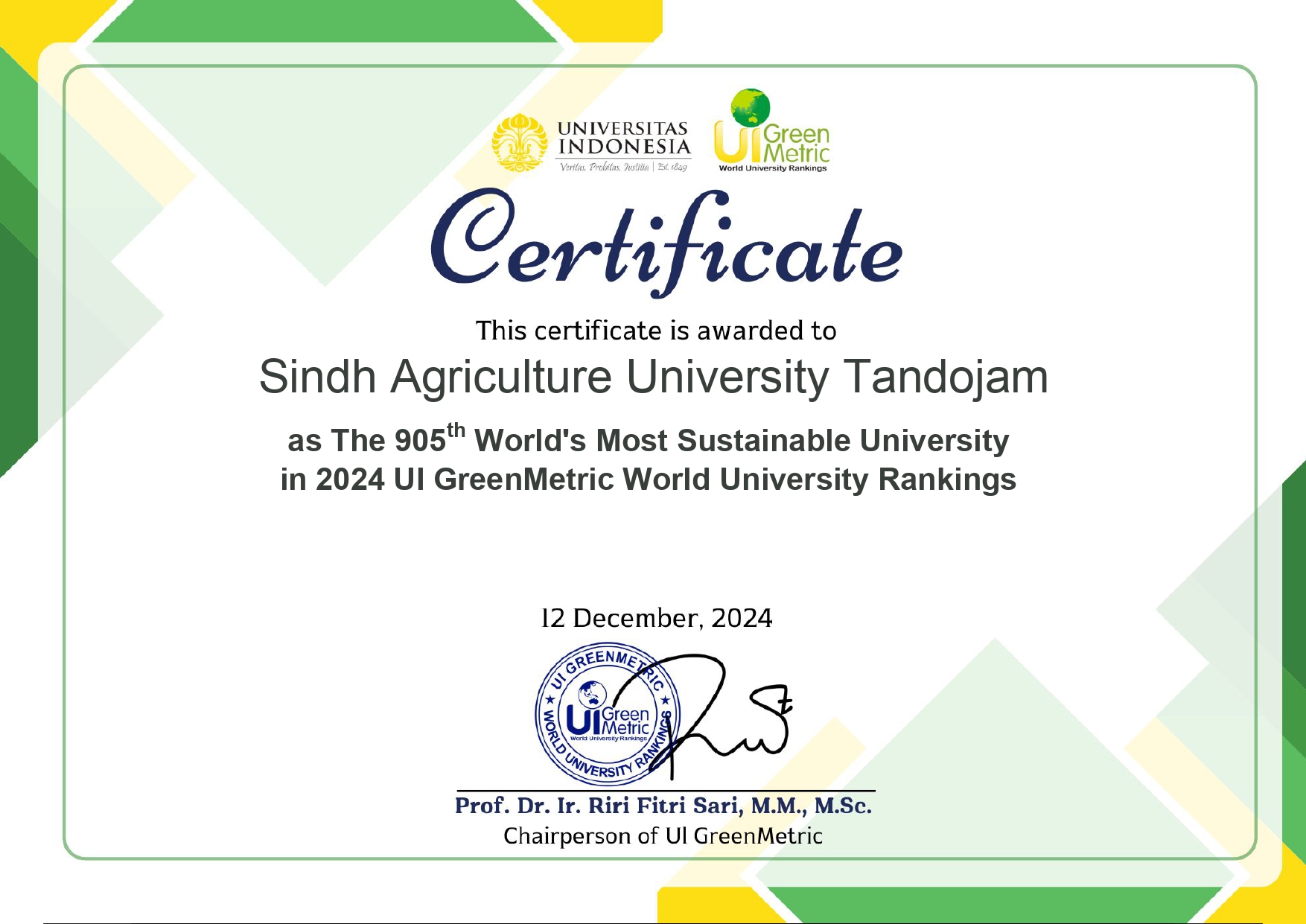
2024
2025
Best World Rank

Rank 702 achieved in 2021

National Ranking 2025

Ranked 46th among Pakistani universities

Methodology & Weightage

UI GreenMetric assesses universities across 6 criteria with specific weightage for each category

Setting & Infrastructure

Green space, campus facilities, and environmental policies

15%
Energy & Climate Change

Energy efficiency, renewable energy, and carbon footprint

21%
Waste Management

3R programs, waste treatment, and reduction policies

18%
Water Management

Water conservation, recycling, and pollution control

10%
Transportation

Green mobility, pedestrian paths, and emission reduction

18%
Education & Research

Sustainability courses, research, and community engagement

18%

UI GreenMetric Evolution

The evolution of the world's leading sustainability ranking for universities since 2010

2010

UI GreenMetric was launched and published for 95 universities by Universitas Indonesia.

2012

Education became a dedicated category. Carbon Footprint and Fact File documents were introduced.

2016

UIGWURN (UI GreenMetric World University Rankings Network) was established.

2019

Three new questions introduced regarding social and economic impacts.

2022

Indicators related to 3R waste programs, student activities, and international collaboration added.

2024

ICT utilization indicators introduced across all categories for better monitoring.

2025

1,745 universities from 105 countries participated. New leadership team appointed.

Committed to a Greener Future

Sindh Agriculture University Tandojam continues to strive for excellence in sustainability, working towards a greener, smarter, and more resilient campus for future generations.

Visit UI GreenMetric Official